"Measurement of the cosmic muon flux at the Stawell Underground Physics Laboratory" - Fu et al (2026)
Alan Duffy
First measurements from 1km underground with the muon detectors at the Stawell Underground Physics Laboratory, paving the way for the dark matter detection program SABRE there - as these muons are a major source of confusion/noise for the dark matter searches globally, and now we know what it is like in the first underground dark matter detector program in the Southern Hemisphere.
Amazing efforts by a team of researchers across the partners at the University of Melbourne, ANU, the University of Adelaide, the University of Sydney and of course, Swinburne. The work is years in the making, with students Fu and Mews all receiving their PhDs through this program, delivered ultimately in this paper by my postdoc Dr Federico Scutti and initiated (and constantly advanced over those years) by my longstanding colleague at UMelb Prof Phil Urquijo.
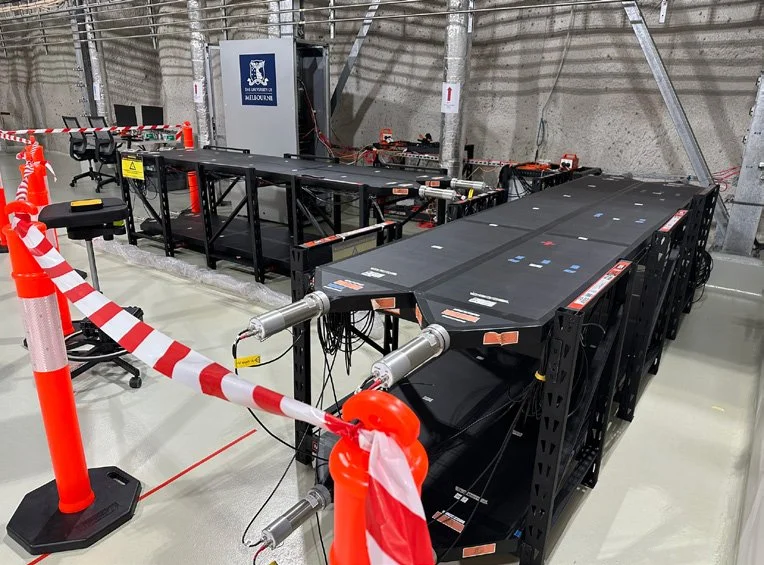
The muon detectors comprise eight 3.0 m × 0.4 m × 5 cm modules and serve a second key role as an additional veto for the SABRE vessel (ultimately sitting atop that dark matter detector). It has been collecting commissioning data with the DAQ (led by Swinburne) since February 2024. The measurement of the time-averaged muon flux in this work is an important commissioning milestone, establishing the background level that could mimic a dark matter signal. Data collected in 2025 will also be further analysed to measure the time dependence and angular dependence of the muon flux, providing a reference for later signal modulation analyses ahead of full SABRE South integration in 2026.